Monday, December 1, 2014

Welcome to Curiosity Science

Thank you all you lovely followers!

I have decided to expand by launching a new science communication project: Curiosity Science. Instead of just chemistry, it will be all science, for anyone curious!

Please check out the new project at: http://thecuriosityscience.com/

Or find us on facebook or twitter! 

Saturday, October 25, 2014

The Immune System: Your Own Person Military

     This post has taken me quite awhile to write, but here is the starting point for our journey to understanding vaccines: the immune system! You can think of your immune system like your own personal army protecting you from outside threats. With this in mind, the first term that we should define is pathogen: an agent that causes disease. Your immune system is designed to protect you from pathogens. 

    Now, at first glance this definition seems pretty straight forward; however, defining a pathogen can actually be kind of a tricky process.  For example, staphylococcus aureus is normally a pretty harmless skin bacteria, but if your skin gets damaged or the staph gets into a spot it really shouldn't be, now it can cause disease. This means that staph is not always a pathogen. This also means that it can take awhile for your immune system to recognise a pathogen is present and thus the infection can take root before your immune system can respond, and thus you get something the picture on the right, which is an MRSA infection.


      The idea with vaccines is to get your immune system to immediately recognise a pathogen and destroy it before it has a chance to cause disease. So who is involved in this very important immune army? We have antibodies, T cells, and B cells. T cells and B cells are also referred to as "white blood cells".  (The oxygen carrying blood cells are called red blood cells.) There is a difference between T cells and B cells in where they are produced and how they interact with antigens, but for simplicity, I am not going to delve into the differences. We are just going to focus on B cells and antibodies


Antigen: This is a marker on a cell that causes a response from your white bloods (B and T). This could be a protein on the cell membrane. Whatever it is, it tells your immune system that this cells is a foreign invader and needs to be dealt with. 

Antibodies: Little Y-shaped proteins that bind to antigens. These are specific to the antigen on a specific pathogen. They are secreted proteins. They roam around your blood system and will bind to the antigen on the pathogen they are specific for when they come across them. This marks the pathogen and allows your white blood cells to destroy it. If you have had a disease, you keep the antibodies that you formed when you were infected and it prevents you from being reinfected.  (Antibodies are also referred to as immunoglobulin or immune globulin.) 

To summarise: your white blood cells (B and T cells) are your body's Swiss army. They are exist to prevent pathogens from invading your body and killing you. When you get a disease, your white blood cells wage war, and usually win. (Again, Swiss army-fierce when engaged.) Your immune system produces antibodies that bind to specific markers on pathogens, called antigens, and this marks pathogens, making them easily removed from your body. If you have never had a disease before, you will end up creating antibodies. If you have had a disease before, then you will already have antibodies, immediately marking the disease cells and preventing you from getting it again. 

   The idea with vaccines is that you trick your immune system into thinking that it has the disease. It produces antibodies, so that when you are exposed to the actual disease, your immune system immediately marks the pathogens BEFORE they can cause disease and they are destroyed by your white blood cells. 

   I said above that your immune system usually wins, so why do we even care about this? Well, just because your immune system may win, it doesn't mean that it does not suffer some losses. For example: measles, you may not die, but you may end up losing your hearing. Mumps: you may actually lose your ability to reproduce. Polio: you may be paralysed for life. And of course, you can actually die. The flu causes over 100 000 deaths world wide every year, and that doesn't even count the millions who have died in massive flu pandemics prior to the advent of the vaccine. 

Coming Up Next: Vaccines: How They are Produced


Friday, August 15, 2014

More on Ebola

    I have already written about the approval of experimental drugs, but it seems that the waters are getting muddier as the ebola outbreak continues to cause problems in Western Africa. One of the most disappointing things that I have seen is that the FDA (US Food and Drug Administration) is now saying that there are cases of fraudulent ebola treatments being sold online. 


    If the problem was not bad enough, now people are trying to cash in on the mass hysteria and sell compounds that have not undergone any testing. You may be asking, "how is this different than using experimental drugs?" Well the difference comes in the form of the fact that the "experimental drugs" that have been approved for use have already undergone preclinical testing by regulated pharmaceutical companies and have been approved for stage 1 human clinical trials. The compounds that are being sold online fall outside the regulated pharma industry, their efficacy and safety have not been tested at all. The best case is that these compounds will do nothing, at worst these compounds will cause more damage. 

  The reason the FDA exists is to prevent this. It is there to protect consumers, and in a disaster such as this ebola outbreak, the consumers are an even more vulnerable population. This vulnerability requires regulatory bodies, such as the FDA or WHO, to be more vigilant of fraudsters looking to make a quick buck.

   While these stories make it seem like the human race is filled with a bunch of greedy bastards with no compassion, take a look at the work by volunteers and employees of organisations like the Internation Federation of the Red Cross Red Crescent for examples of people willing to make a difference and help their fellow humans. 

Experimental Ebola Drugs Now Approved for Use

     The recent Ebola outbreak in western Africa has been something that has captured the world's attention, especially with its high death toll. The question has been how to treat the disease as currently there is no vaccine and the drugs are experimental. On Tuesday, the World Health Organisation met to discuss the ethical implications of using experimental drug treatments on ebola patients. The BBC shared an article earlier this week explaining some of the issues. 

    If you need a bit of a refresher on how pharmaceuticals are produced, check out an earlier blog I wrote on how pharmaceuticals are produced. There are a lot of regulations to go through and only about 1% of the compounds that make it successfully through the animal trials (such as the ebola drugs) are likely to make it through the human clinical trials. 

    The other huge challenge with these experimental drugs is that there are limited supplies. Canada has committed 1000 doses of the experimental vaccine.
But why only 1000 doses when so many people are affected? Why can't we just give out more doses? Well this all goes back to how these compounds are produced and the regulations that surround their production. 

     Early in the testing cycle of pharmaceuticals, you don't need tens of thousands of kg of product, so only about 1-10 kg of product are produced. While clinicians are testing the efficacy of the drug on patients (or animals-depending on phase), process chemists are testing the synthetic pathway. This pathway has to be cost efficient, it has to follow the regulations of good manufacturing practices, and it has to be scalable. Of course, all of this has to be safe. What works on a research lab bench is not always safe or practical on the large scale of production in the pharmaceutical industry. 

    Finding a drug/vaccine, making sure it works, making sure it works in human trials are only part of the testing that happens. The synthesis is also important. Every synthetic reaction has by products. Not only do you have to test the safety of the product that you want, you also have to test the safety of the by-products of the reaction. You have to demonstrate that they are being removed effectively. This process also needs to be approved by the regulatory bodies. The process is continually optimised during the life time of the drug. 

   Synthesis also takes are really long time. I remember teaching a postdoc in the lab I did my PhD in how to do a simple esterification reaction. (He was not from a synthetic background.) I remember him being shocked at how long making the compound took, even though it was one step. He figured it would be a couple hours of work and it ended up taking him 2 days to synthesise, isolate, and purify the compound. This is why I found it funny when people figured that the H1N1 flu vaccine circumvented proper testing and regulation when, during the mass outbreak, all of the sudden the vaccine was available for that strain within a couple weeks. It wouldn't have even been physically possible to come up with a new vaccine in two weeks, but let's save influenza for another blog entry in this vaccine series.


Monday, August 4, 2014

Dear Pro-Vaxxers: Let's Lay Off Jenny McCarthy

         Vaccinations: I am guessing that by clicking on this entry you are expecting either some fear-mongering piece on how vaccinating your kid will make them more sick than the disease and it is all pseudo-science or you are expecting a self-righteous piece on how vaccines are safe and those not vaccinating your kids are guilty of child abuse and you are responsible for the deaths of babies. 

         Sorry to disappoint, but this particular blog is my attempt to recognise that people who offer trepidation about vaccination do have some valid questions and they should not be mocked for asking them. I am writing to the pro-vaxxers: we have the science on our side, let's maybe stop calling people who question it idiots and maybe instead help them understand. By being combative, we are not doing anything to stem the anti-vax movement, and that is something that impacts all of us.

       The anti-vax movement can be traced back easily to Andrew Wakefield's fraudulent studies on a relationship between autism and the MMR vaccine. I don't really feel like going too much into Andrew Wakefield as I would equate him to the Bernie Madoff of science. There have been no less than 16 000 peer reviewed papers by reputable scientists in everything from epidemiology to chemistry who have since studied vaccines and found that there is no link whatsoever and we should all line up and get the shot. The damage done by this study is upsetting.

      So why then are people still buying into the "anti-vax" movement? I would have to say that such a study simply caused people to ask questions that previously they just accepted: what is in these vaccines? Why do I have to get so many? How are they tested? How do we KNOW they are safe? It obviously didn't help that high profile celebrities like Jenny McCarthy and Jim Carey were often seen at anti-vax rallies and Jenny McCarthy even wrote the introduction to Andrew Wakefield's book. 

Ah, Jenny McCarthy-she is really why I am writing this particular entry because recently she has backed off her "anti-vax" stance writing an op-ed piece for the Chicago Sun Times stating “I believe in the importance of a vaccine program and I believe parents have the right to choose one poke per visit. I’ve never told anyone to not vaccinate.” Well you know the internet, this immediately caused a backlash of people calling her a hypocrite, citing every "anti-vax" statement she ever made. There is even a website called Jenny McCarthy Bodycount which shows the number of preventable deaths caused by previously eradicated diseases. 

      I am a staunch pro-vaxxer. It is in the interest of public health that we get vaccinated. It is how we will cure diseases and ensure no one ever gets them. Seriously, if you are the kind of person donating money to any sort of disease cure, chances are some of that money is going toward finding vaccines. With all this in mind I was utterly disappointed to see the reaction toward Jenny McCarthy's change. DEAR PRO-VAXXERS: THIS IS WHAT WE WANT! We want people to realise that vaccines are important to the health and safety of everyone in society. We want people who were previously anti-vax to take comfort in the science of vaccines and recognise their importance and feel comfortable in choosing vaccination for them and their children. People are not likely to do that if they see someone like Jenny McCarthy get completely torn apart for changing their mind. I, for one, think it was a brave move of Jenny McCarthy to write a piece explaining that she now has a more "pro-vax" stance.

      As a matter of fact, there have been studies to show that in the face of all the evidence, people are less likely to change their minds. We are not going to make easier by being jerks when someone decides to change their minds. 

"Dumbledore says people find it far easier to forgive others for being wrong than being right," said Hermione.  (Harry Potter and the Half Blood Prince, page 95)

      I really feel that as scientists we need to be more accessible as experts. We need people to start realising that we are the "real doctors" and that there are more resources out there to get the answers than their general practitioner physician. Don't get me wrong, physicians are great. They are great at what they do but they are not experts. They refer you to oncologists, surgeons, dermatologists, etc., when you need an expert for a medical malady. This works the same for research. Physicians are not experts. They rely on the work of experts and yet they are the ones that have to field the questions. Let's help physicians out and get the experts out there because an immunologist is much more suited to addressing the question of "why do I have to get my baby vaccinated every 2 months?" than your public health nurse or general physician. Again, let me stress: public health nurses and physicians are great-but they are not the only resource.

       All of this has inspired me to dedicate a series of my blog entries just to vaccines and their importance. I hope to provide peer-reviewed, cutting-edge research answers to the way vaccines work, why we need them and why they are important. Ms. McCarthy states in her op-ed that maybe the vaccine schedule that the doctor prescribes is too much. Well Ms. McCarthy, there is actually a reason for that schedule. It is important to ensure the efficacy of the vaccinations and I am going to write about why it is important to get your vaccines on schedule, as well as many other things so that you, and other concerned parents like you, can get the most accurate, scientific data out there to allay your concerns.  

     So for all of you, pro or anti-vax, I hope you keep reading my series with an open mind to learning something new. For all of you pro-vaxxers: please be kind when talking about the vaccine debate. I know that it can be frustrating, but remember that much of it started with simple questions, which is something that as scientists, we embrace. We have the science on our side; we don't need to resort to childish name calling or "anti-vax shaming". Shaming has never been a winning strategy. We are not trying to win a debate. We are trying to provide information that makes parents feel that they are doing the right thing by vaccinating their children. For all of you anti-vaxxers: please keep an open mind to peer-reviewed science. You should always feel comfortable asking questions about why your child is receiving any kind of treatment, but you should also know where to get answers that are based on fact. Unfortunately the internet is a big place and anyone can post whatever they like. It can be a challenge just to sort out what sources are valid and which ones are not. Vaccination is about more than just you and your child, though: it is about community health.


Next: The Immune System: What Exactly are We Designing Vaccines For?


Sunday, December 8, 2013

Science Policy and Communication

One of my favourite topics to get up on my soapbox about is science policy and that not enough of the policy makers have a true understanding of science. Now part of my usual rant with has to do with the fact that I am not blaming the policy makers for this, but rather chiding the apathy of the scientific community for not being more active in the policy making role. And that isn't entirely the fault of the scientific community either. Have you ever seen "question period" in the House of Commons? I would rather slide down a banister of razor blades and land in a pool of alcohol than participate in that. 

For me, I just want people to understand small things like what you read on the internet isn't necessarily factual or that medical doctors aren't experts in science and scientific studies are still done by humans and can have mistakes.

Things that can help people learn to read science without spending 11 years in university (yes, I spent 11 years in university study science and chemistry) are nicely summed up in this Nature article. We are at a point where information is so easily accessible. Now it is time to learn how to sort and process that information in a meaningful way. 

I personally love talking about science and all things science so that I can learn and I can teach. It is one of my favourite things to get other people as passionate for science as I am. And if I can teach you something then I feel my job here is done. Hence why I have this blog. I may not be able to write often, but I do love when I get the chance to write about something I love as much as science. 

Friday, June 14, 2013

Biodiesels

I am currently writing my dissertation for my Ph.D. entitled "The Use of Canola Oil as a Carbon Feedstock in the Synthesis of Value-Added Materials". One of the things that happens when writing a dissertation is that you do a lot of reading about interesting points tangential to your actual project. Since I am working with canola oil, I devoted a special section of my introduction to biodiesels, since 80% of the biodiesels used in the EU are made of canola oil. (They call it rapeseed, but it is canola oil.) I thought I would share some of the chemistry of biodiesels.

First, let's start with a little history. Did you know that diesel engines were originally designed to run on a renewable fuel source? In 1900, Rudolph Diesel presented his engine, which was powered by peanut oil, believing that biomass fuel was the future of the engine. However, come the 1920s, engines were altered to use the lower viscosity petrodiesel which was much cheaper to produce. This remains one of the huge challenges in sustainable development: economics. How much are you willing to pay for fuel because while the $1.30/L (Canadian pumps in Alberta) is pretty steep, it is still cheaper than biobased fuels because of the mass production infastructure. But I digress; this is a chemistry blog. 

Peanut oil is not technically a biodiesel. Biodiesels are transesterified vegetable oils resulting in fatty acid esters, most commonly the methyl ester. The vegetable oil is reacted with an excess of methanol in the presence of an acid or base catalyst (industrially it is usually the base sodium methoxide) to produce 1 equivalent of glycerol and 3 equivalents of fatty acid methyl esters. These are referred to as FAMEs. What is awesome about biodiesels is that they can be used directly in compression engines without modification to the engine and they can also be blended with petrodiesels because they are completely soluble. Because they come from plants, the carbon dioxide and water produced by the burning of the fuel are taken back up by the plants resulting in overall reduction in emissions. There is also a reduction in carbon monoxide, sulphates, particulate, and total hydrocarbon emissions. Which is all pretty great. 

But of course there are some major drawbacks. First, cost. As I have alluded, price plays a big role in industrialisation and biodiesels are currently a lot more expensive to produce compared to petrodiesel. Second, poor cold performance. This is actually a concern with diesels in general. But these longer chain fuels begin to solidify at higher temperatures. Huge problem in a place like Edmonton, Alberta where in the winter it is common to get temperatures well below -10 C. This is also why diesel engine vehicles require a block heater. Fuels need to remain liquid and low in viscosity to actually perform well. Third, and I think this is really important, is that the greenhouse gas (GHG) emission savings is much lower than expected, failing the sustainability requirements. The EU's Renewable Energy Directive (RED) demands a 35% reduction in GHG emissions compared with petrodiesels for biodiesels. They have estimated that canola-based biodiesels result in a "typical" 45% reduction while commonly using the default number of 38% in GHG savings. 


However, a recent study by Gernot Pehnelt and Christoph Vietze refutes these claims and points to GHG savings of, at best, 29.7%.  The authors claim there was a lack of transparency in the calculations performed by the European Commission. Running a life cycle analysis using the same basic methodology and background data as RED, and only utilising publicly available and published data in their calculations, the authors were unable to replicate the numbers reported by RED. Further, these calculations did not take into account for any of the other environmental or social impacts associated with using available agriculture land for fuel, which they argue would further decrease the sustainability of canola oil biodiesel. 

Another huge concern with biodiesels is that glycerol is produced as a by-product. The global production of glycerol has grown exponentially, well passed the global demand for this chemical. 

As we move toward a more sustainable future, it is important to recognise that the after over one hundred years of industrialisation based on petroleum fossil fuels, our journey has no quick solutions. It will be a long and complex movement, but with every step, even the smallest, we are that much closer to a sustainable future. This must be a global movement.

References:

Brown, B. A. Ph.D. Dissertation, University of Alberta, Not Yet Published.
 
Bart, J. C. J.; Palmeri, N.; Cavallaro, S. Biodiesel science and technology; Woodhead Publishing Ltd.: Boca Raton, FL, 2010.

Huber, G. W.; Iborra, S.; Corma, A. Chemical reviews 2006, 106, 4044–98.

Cheng, J. Biomass to Renewable Energy Processes; Taylor and Francis Group: Boca Raton, FL, 2010.

Ragauskas, A. J.; Williams, C. K.; Davison, B. H.; Britovsek, G.; Cairney, J.; Eckert, C. A.; Frederick, W. J.; Hallett, J. P.; Leak, D. J.; Liotta, C. L.; Mielenz, J. R.; Murphy, R.; Templer, R.; Tschaplinski, T. Science (New York, N.Y.) 2006, 311, 484–9.

Spellman, F.; Bieber, R. The Science of Renewable Energy; CRC Press, Taylor and Francis Group: Boca Raton, FL, 2011.

The Economic Impact of Canadian Grown Canola and its End Products on the Canadian Economy; 2011.

Knothe, G. Energy & Environmental Science 2009, 2, 759.

Gilbert, N. Nature 2012.
 
Pehnelt, G.; Vietze, C. Jena Economic Research Papers 2012, 39, 1–35.


Friday, February 15, 2013

A Yarn of Chemistry: All Ewe Knit to Know-Part 2

In part 1, I dealt with the chemistry of animal fibers: wool and silk. But animals are not the only source of fibers that we use for making yarns. Another source is from plants; these are termed "cellulosic fibers," as they are all primarily comprised of cellulose. I plan on covering cotton, linen, and hemp in this section. (The photo on the left is me in a yarn shop in Heidelberg, Germany.)

To begin, let's talk about the structure of cellulose. It is a polysaccharide. This means that it is a polymer (made of many units) and the repeating units are "saccharides" also called sugars, or carbohydrates. In cellulose there is only one sugar that is repeated to make it a polysaccharide. That sugar is glucose. Now this might surprise some people because we use glucose all the time: it is in starches, and refined table sugar, and the bowl of candy on my desk, all of which we eat and digest. But we cannot digest cellulose. And yet the part of the potato we can digest is made of the same stuff that the part of the potato that  we peel off because we can't digest. This has to do with how the glucose units are strung together. 

The picture on the right shows two molecules of glucose put together: the bond between glucose molecules is called the glycosidic bond and is highlighted in red. On the top is an "alpha" bond-this is how glucose that we can digest is arranged, so like starch. On the bottom is a "beta" bond-this is how cellulose is put together. Most animals do not possess an enzyme that allows them to break beta bonds and therefore they cannot digest cellulose. By having beta bonds in place of alpha bonds, the chain of glucose molecules becomes more linear and more rigid. This is why cellulose is used in plant cell walls: the rigidity gives the plant strength. 

Probably the most important cellulosic fiber is cotton. This particular fiber, unknown in Europe until the Middle Ages, is most associated historically with the growth of slavery and the industrial revolution. The fruit of the cotton plant produces bolls, in which the seeds are wrapped up in a mass of cotton fibers. The cotton plant requires long, hot summers, well drained soil, moisture, and no frost: this is why Canada has never been known for its quality cotton. There are many countries around the world that manufacture cotton, but the conditions that it is grown in can impact the properties of the fiber. The cellulose chains in cotton long and linear, due to the beta bond, discussed vide supra; this allows many chains to pack closely together and interact with each other through the formation of hydrogen bonds, making it highly crystalline.These cellulose fibrils are then arranged in essentially three layers that are spiraled together, resulting in the high strength that cotton is known for. This is important to know when working with cotton yarn because they are less stretchy than wool, and will show any mistakes or irregularities in your work. This can be quite frustrating for new crocheters or knitters. The other thing I have found when working with cotton is that the individual plies of the cotton yarn don't stick together as well as they do in wools, making really easy to put your hook through the strand. There are different standards of cottons. The longer the length of the fibers, the softer and nicer (and consequently more expensive) the cotton is. Egyptian cotton fibers are between 25-65mm, this is what makes them so lovely. American cotton is between 10-25mm. Another interesting property is that the fibers are actually stronger when wet.

Cotton is easy to wash, breathable, absorbent, and less of an allergen than wool. It also dyes very well, meaning that it can be found in all sorts of great colours. One of the most common projects for cottons is dish clothes and towels, like the set I made on the left. Because you are going to be pretty hard on dish cloths, you don't want to use high quality cotton, go with shorter, rougher cotton. Now when making something for a baby, cotton is not a bad choice. I most recently used cotton in a baby blanket. Anything you are making for a baby, you want to make sure that it washes easily because it WILL get dirty and they aren't going to be gentle with it. Here is a great project for a nicer cotton. The longer, softer fibers make a nice blanket. 

The next type of cellulose fibers are called "bast fibers". These are ones that are derived from the stem of the plant. Unlike cotton, these fibers are part of the structural make up of the plant, and the job of holding it up requires a lot of reinforcements, meaning that these cellulose fibers are mixed with a bunch of other things like: pectins, gums, waxes, lignins, and hemicelluloses. 

Linen has to be one of the oldest, if not the oldest, cloth fibers. Seriously, hop in your time machine and head to Egypt in 8000 B.C. and you will find linens.  This prized cloth is made of fibers isolated from the flax plant. Flax fibers are found at the surface of the stem and run the whole length. Since the stem is about a metre in length, you can see how flax fibers are longer than cotton fibers, ranging from 6-65mm (average length is 20mm). Flax fibers are also stronger than cotton fibers; actually this is one of the strongest naturally occurring fibers. Like cotton, linen is light-weight and absorbs water readily. It is easily laundered and takes dye well. It is a good conductor of heat, which is why it is so nice to wear in hot climates. As a dense fiber, it drapes well, but it also wrinkles super easy. Look at it the wrong way and it will wrinkle. Its stiffness can make it a challenge to work with, especially if you are just learning, but the history makes it an interesting choice too. 

Hemp is another bast fiber that is used in textiles. But for those of you who would like to use hemp as a reason to legalise marijuana, I hate to inform you, but that is a different plant. While they are of the same genus, the hemp cultivar only contains a small amount of THC. The amount of cellulose in hemp fibers is lower than in cotton, and it tends to have lignin in it. This makes it rougher and stiffer than cotton. But being long, at a typical 15mm length, and strong, it lends itself well to the production of ropes. I have never seen a yarn made of hemp in the shops I frequent, but I am positive there are some out there. 

A relatively newer cellulosic yarn is that derived from bamboo. These fibers are quite long at 38-76mm. Bamboo is super absorbent. The fibers tend to be smooth and round, leading to the soft feel of the yarn, as well as its low irritability, making it ideal for projects for anyone with sensitive skin, like babies. It also has a lovely sheen to it.

Coming up in Part 3-synthetic yarns!

References:

Stoller, D. Stitch'N'Bitch: The Knitter's Handbook 2003, Workman Publishing Company, Inc. New York, NY.

Crowfoot, J. Ultimate Crochet Bible 2010, Sterling Publishing Co. New York, NY.

Pratt, C. W.; Cornely, K. Essential Biochemistry 2004, John Wiley & Sons, Inc. Hoboken, NJ.
Mather, R. R.; Wardman, R. H. Chemistry of Textile Fibers 2011 Royal Society of Chemistry.

Le Couteur, P.; Burreson, J. Napoleon's Buttons 2003 Penguin Group, New York, NY.
  

Monday, January 14, 2013

A Yarn of Chemistry: All Ewe Knit to Know-Part 1, Proteins

One of my favourite hobbies has become the craft of crocheting, and I am in good company with my mum, gramma, close friends, and even Queen Victoria. I find this craft to be incredibly relaxing, giving me something to do while I try to relax my mind after working.  I can take it anywhere, it is super portable, as evidenced by the picture on the left, which is me crocheting in the Zurich train station while traveling in the summer. I will crochet while teaching in a help room and I found this very beneficial in keeping me calm when dealing with even the most difficult of students (which is NOT the majority of the students I teach) and also keeping me from getting bored when students didn't have a lot of questions without making me difficult to approach. You can hold a conversation, watch a movie, listen to a presentation all while crocheting. I do also know how to knit; however, I have yet to ever finish a knitting project. I find crochet to be faster, simpler, and easier to pick and put down-but that is my preference. A good many ladies in my department also crochet/knit, and like many things in life, this craft is filled with chemistry. 

When you start a craft like crocheting or knitting there are a few important things that you need, namely the hooks (if you are crocheting) or needles (if you are knitting) and yarn. Yarn is the general term for fibers that have been spun together. With the yarn comes a number of options and this can be daunting for a newbie. What is the difference? What does it all mean? What yarn is best for what project? What is the difference between wool and yarn? Well there are three main categories for yarn types: protein fibers, cellulosic (or plant) fibers, and synthetic fibers. Each type has pros and cons and is best for different types of projects. Because there are three different types, I have decided to break the entry into three different parts. Today's part is brought to you by protein fibers.

Protein fibers are animal in origin and are, as the name suggests, comprised of proteins, so before we can discuss protein fibers we need to discuss proteins in general. What is a protein? Proteins are large, 3-dimensional structures that are made up of amino acids (pictured on the right). There are 20 natural amino acids and they differ only at the position I have labelled "R". This R group gives each amino acid unique properties which, when many amino acids are strung together, will result in the protein properties. A string of amino acids makes a polypeptide. There are four levels of protein structure. The first level (called primary) is the specific sequence of amino acids strung together to make the polypeptide. This is determined by DNA code. The second level (called secondary) is localised conformations, which is created by the was that neighbouring amino acids interact with each other. The third level (called tertiary) is the over three-dimensional structure of the entire polypeptide. The fourth level (called quaternary) happens in proteins that are made of many different polypeptides. Now I find all of this very cool because muscles and hair are two very different types of proteins, but each are made up of the same 20 amino acids and simply differ by how those 20 amino acids are put together, which is what creates the overall shape, and thus the function. What I find even more awesome is that those 20 amino acids are dictated by the four base pairs in DNA. So depending on how those four base pairs are oriented in your DNA will determine what sequence the 20 amino acids in your proteins are put together, which will ultimately determine the protein function and that results in this amazing thing called life! But to carry on with my Ode to DNA I digress from the point of this entry, which is protein fibers. 

The first, and major, type of protein fiber is wool. Wool comes from sheep (and sheep-like animals). But not all wool is created equal. Different sheep give different wool. There is huge variation in the structure of wool (just like the variation in the animals themselves) and the overall structure is pretty complex. For the interest of crocheters and knitters I am going to focus on pure, fine wool. Raw wool can contain 30%-70% impurities. Pure wool is almost entirely protein. Wool is characterised by its diameter, length, and crimp (how curly it is). Smaller diameters, shorter lengths, and more crimp result in finer, warmer wools and super soft wools, really really soft wools (I can't stress that enough).

The basics of the fiber can be boiled down to the outside, which is called the cuticle, and the inside which is called the cortex. The cuticle is about 10% of the fiber and results in the surface properties of wool. What is most interesting about the cuticle is that the cells are put together like scales, i.e. they overlap, and this creates directional friction which means that the fiber is smoother (less friction) in one direction compared with the other direction. This is what makes wool so easy to spin into yarn, but also what causes it to felt and shrink because the scales cause the fibers to get entangled and thus felted. The cortex results in the overall structure of the yarn. Depending on how the cortex proteins are put together will influence the amount of crimp in the yarn. 

The protein that makes up wool is called keratin. Wool is over 80% keratin. What makes keratin interesting is that it is high in the amino acid cysteine. The R group in cysteine is CH2SH. The remaining amino acids cause the protein to adopt a helical structure and then the cysteine amino acids in two protein strands bond together. The result is two protein fibers that are coiled together and then cross-linked through sulfur bonds, making them pretty strong. (Side note: sulfur-sulfur linkages are also what give vulcanised rubber its strength.)

Let's compare types of wool: 1) merino wool is soft, not terribly expensive, but does pill. Its fibers are 17-25 micrometers in diameter. 2) Mohair-this is wool that comes from the angora goat (not to be confused with angora wool, which is made of bunny fur). Mohair is a little coarser at 25-45 micrometers in diameter, but is quite fuzzy. I have used it in a blend for a sweater, super nice. 3) Alpaca-oh how I love thee alpaca. Alpaca wool is from, shockingly, alpacas. On the left I have a picture of my Queen Victoria scarf that I made using alpaca. It happens to be the second softest yarn I have EVER put my hands on. Alpaca is 18-25 micrometers in diameter (remember smaller is softer and warmer) and I can tell you that this little number is very VERY warm, which is helpful up here on the prairies. Actually, this particular pattern is nice with a yarn like this because the space between double crochet clusters keeps you from over heating. I have another alpaca scarf that is much more densely crocheted. It is also super soft, but I won't wear it if it is warmer than -10 C because it is just too hot. 

4) Cashmere-and on the right we see a picture of the softest yarn I have ever felt. Cashmere is combed from the bellies of cashmere goats and is very fine, at no more than 19 micrometers in diameter. Naturally this makes it more expensive (those little 50g balls are $26 CND each), so I have a very special plan for those two little balls. Now both alpaca and cashmere are less durable than merino wool, something to consider when planning your projects. 

The other type of protein fiber is silk, which is produced by some very specific moth larvae (a.k.a. silk worms.) Basically when it is time for those larvae to morph into moths, they excrete a thread of the protein fibroin out of its head and glues it together with a protein gum, wraps about 2 Km of it into a cocoon, under goes its metamorphosis and leaves the shell of its cocoon behind to be unraveled and degummed and sold as silk. Since it is already a thread, silk doesn't need to be spun to form yarn, the silkworm already took care of that. So instead of keratin (the protein in wool), silk is fibroin. This protein has very little cysteine in it, and therefore doesn't have sulfur bonds holding the fibers together. The main amino acids in fibroin are alanine and glycine, which are the smallest of the amino acids. This means that the silk fiber is more crystalline, and less stretchy. It has more tensile strength than wool, but tends to be more brittle. These fibers are 15-25 micrometers in diameter. This makes silk quite soft. It is also quite light. But it is also quite expensive. It is shiny though. It makes a good choice for a shawl or wrap. 

Coming up in part 2-cellulosic fibers: cotton, linen, bamboo.

References:

Stoller, D. Stitch'N'Bitch: The Knitter's Handbook 2003, Workman Publishing Company, Inc. New York, NY.

Crowfoot, J. Ultimate Crochet Bible 2010, Sterling Publishing Co. New York, NY.


Pratt, C. W.; Cornely, K. Essential Biochemistry 2004, John Wiley & Sons, Inc. Hoboken, NJ.

Mather, R. R.; Wardman, R. H. Chemistry of Textile Fibers 2011 Royal Society of Chemistry.

Wednesday, December 26, 2012

Can't Sleep, Thesis Will Eat Me

I know I have been remiss in writing here lately, and I greatly appreciate the number of comments/questions. Too bad it has taken me so long to get back. I shall blame it on writing my thesis. After spending an entire day writing (or staring at a blinking cursor, trying to write-depending on how good my day is) I just don't seem to want to write more on my blog. Although, this is much more fun. 

But with all of the writing I have been doing, I have had the luck of getting a paper published. It is one I have been working on for more time than I care, but the scientific community has agreed to publish it (who am I to argue?) so here is a link to my paper , just to prove that I am a real scientist with actual real credentials. 

I intend to write something here soon, but please don't let my slow response keep you from reading, or asking questions. 

Chemistry is awesome!

Thursday, September 20, 2012

Operation Thesis Continues

I am still working away at my thesis. It really means that I am having trouble coming up with ideas for blogs on my own. So please ask me some questions. I am desperate for new ideas to write about. I have a few thoughts, but maybe some feedback with let me know whether there would be any interest:
1) vaccines-what they are and how they work

2) fluorescence-because of that whole mountain dew myth

3) what is a flame? This might really be my attempt at answering Alan Alda's "what is a flame?" challenge. 

And I am out. Please ask your questions. And also vote on whether or not you would like to see a post about any of the above topics.
 

Saturday, August 11, 2012

Ask a Chemist: Operation Thesis

It never fails that when I am away for a bit, that is when I get numerous questions. I apologise for my delay in replies. 

Please keep your questions coming. 

I have begun writing my thesis. The completion of this masterpiece is under the label: Operation Thesis. Along the way I shall be happy to share what I learn. Also, I am looking for the distraction.

Tuesday, July 3, 2012

Happy (Belated) Canada Day!

This past weekend was Canada Day. And tomorrow, for Americans, is Independence Day. Common to both of these holidays is celebrations that demonstrate the best use of gunpowder. What I mean to say is FIREWORKS! Without chemistry there would be no fireworks so to share a little about the chemistry of fireworks let me introduce you to a video from the American Chemical Society. Chemistry of Fireworks.
Enjoy!

Friday, June 1, 2012

Chemisty of Stain Removal

I am just returning home from the 95th Canadian Society for Chemistry conference, which was hosted in Calgary, Alberta this year. One of the great things about going to Calgary for me (aside from visiting the zoo) is that my sister lives there. Instead of staying in one of the over-priced hotels near the conference centre, I was able to stay in one of the over-priced downtown apartments near the conference centre. This was great! And sure, the accommodation may not have had the most comfortable bed, it did come with free internet, home cooked meals, and a couple of cats to snuggle with. Oh, and family that I love. In this time though, my sister found that having a free-loading chemist as a house guest isn't all that bad. Not only will she leave her fabulous shoes for you to wear, she can apply her knowledge to help you remove a baked-in oil stain from one of your favourite sweaters.

The stain: in an expensive and great lululemon zip-up hoodie, an oil stain that was very visible was set in the pockets. The sweater had been machine washed and dried. Its distraught owner was quite sure nothing further could be done for the sweater. It was to fall victim to this villainous stain. 

Our heros: a chemist, canola oil, and dishsoap. The canola oil was rubbed into the stained areas. Then dishsoap was poured on top and also rubbed in. The sweater was then thrown back into the washing machine.

The outcome: one stain-free sweater, good as new.

That's right, we used oil to remove oil. Magic right? Not so. Here's the chemistry: because the oil had been washed and dried, it was now trapped in the fibers of the fabric and therefore  not accessible to soap when further washing would take place. This is because water and oil, as the saying goes, don't mix. This creates a barrier between the oil in the fibers and the soap. In order to get the oil out then, we need to find a medium that it does mix with. This is where the chemistry phrase "like dissolves like" comes in. Oils are soluble in other oils. Any oil will do: canola, olive, WD40, take your pick. By rubbing the oil onto the stain, it is able to dissolve the oil that is set into the fabric fibers. Once it has, you pour on the dishsoap, and the soap does what soap is designed to do, and form what are called "micelles" around the oil particles that can now be washed away in water. The result is a stain-free fabric. 

I talk a little bit more about some of the factors involved in my blog about water. The terms hydrophobic, hydrophilic all play a role in this chemistry. Oil is hydrophobic: water-hating. Soap is what is called "amphiphilic", meaning that one part of it likes water, while the other part doesn't. When placed in water it will arrange itself in the small spheres (micelles) with the hydrophilic (water-loving) part facing out into the water, the hydrophobic part facing in. Because oil is also hydrophobic, it ends up on the inside of these micelles, away from the water.    

So there you have, practical chemistry to save your clothing from destruction!
 

Wednesday, May 9, 2012

Starbucks is Serving What?!

I dedicate this particular post my sister. 

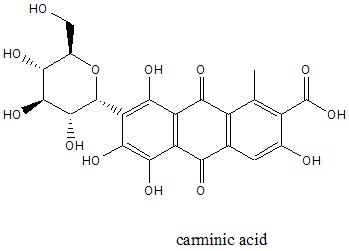
Basically what I gather is that some person found out that their red or pink food dye that makes their Starbucks frappuccino a delicious-looking pink came from insects and this caused some vegans to get upset since apparently bugs count in the abstinence of eating animal products. You can step on them, you just can't eat them. Whatever, that's not really what I care about. What I care about is the chemistry, so let's talk about this red dye:

It is carmine. Carmine is the aluminum salt of carminic acid (shown above). Carmine is also know as natural red 4. Where does the "natural" come from? "Natural" means that it has been isolated from nature, meaning not synthesised in a lab by chemists like me, otherwise it would be referred to as "synthetic" or "artificial". In this case, carminic acid (and similar compounds) are isolated from the scales of insects. There are various methods to prepare this compound, and the more pure, the deeper the colour. 

This is the red in lipsticks, paints, inks, and food products. There have been instances of allergic reaction to this compound-as with most other chemicals, both natural and artificial. 

So if natural is not what you want in your food (FYI you can add this naturally derived chemical to juice and still label your product as having not artificial colours) and you would prefer not to have bug extract in your food, what is left for you is synthetic dyes. 

Synthetic dyes are ones that are made in labs by chemists like me. I like the idea of Starbucks having to switch to synthetics-it means I will be employable. (Ok, I am being a little facetious there.) Synthetic isn't bad either. Food dyes, cosmetic dyes are treated like any other consumer product and have to meet certain legislated standards, not unlike what I described for pharmaceuticals. But the draw back of going synthetic means that there will be some chemicals that have been derived from oil that are used in the process. It is all a trade off.  This particular compound, carminic acid, was first synthesised in 1991 in the lab of John Tyman: Journal of the Chemical Society-Chemical Communications, 1991, 18, 1319-1320.

While many dyes and pigments are derived from plants, not all are. This is a case where insects are used. Tyrian purple, also known as royal purple, was obtain from a kind of shellfish.

Thursday, March 8, 2012

Pharmaceuticals-How Are They Produced?

I thought I would talk a little about pharmaceuticals. Chances are you take some, know someone who takes them, and have all complained about their prices. This past semester, I took a pharmaceutical chemistry class taught by scientists from Gilead, and I must say it was very enlightening. I thought I would share some of the lessons I learned and some of the key problems that face those charged with making these chemicals that many people depend on.

Let's start with a poignant news story. What would you do if you were suddenly unable to get a hold of a medication that you require? When a company decides to stop producing a compound, what can be done? Is that right or wrong? How should medications be priced? These are questions that are very difficult to answer.

To understand a little bit about the complexity of the issues with the pharmaceutical industry I think it is first important to understand how these medications are produced. I know I found it eye opening. Guess how long it takes to produce a drug? 0-5 yrs? 5-10 yrs? 10-15 yrs? 15-20 yrs? If you guessed 15-20 yrs, then you would be correct. It takes 20 years and (as of 2008) $1.7 billion to develop a SINGLE drug. 

The timeline:

Discovery/Preclinical Trials
Time: 1-3 years

In this time, the company will begin by identifying a medical need, such as anti-HIV medications, and then study that disease to determine where drugs can target the disease and the possible interactions of the drug. This is where potential contenders for a drug are determined. This amounts to some 30 000 chemical compounds will be screened! These preclinical trials will involve pharmacodynamics and pharmacokinetics.

Pharmacodynamics: studies how a drug interacts with a target-this is the impact of the drug on the body. Is the drug going to do what is was intended to do? Is it going to do something else? 

Pharmacokinetics: this is how a drug is transported to the target-this is really looking at the impact of the body on the drug. This looks at four things: absorption, distribution, metabolism, and excretion. Remember, your body is one self contained complex chemical reactor. I think one excellent example of the importance of studying this effect is the notorious thalidomide. There are two versions of thalidomide: R and S. One is an anti-emetic (R) while the other causes birth defects (S). Yes it is possible to separate the two and give a person only the version that DOES NOT cause birth defects; however, once in the body, the drug is inter-converted to the other form (a process called racemisation).

Any potential drug will be screened for toxicity using two species: one rodent and one non-rodent. They will be tested for single and repeated dosing. They will be tested by various delivery methods. (Side note: a 14-day rat trial costs $250 000.)

During this time, chemists will be answering the questions of: can the drug be made? How many steps (hint: more steps, more costly, more trouble)? What are the yields (not all chemical conversions give 100% yield-actually very few give 100%)? Is chemical manufacturing possible, feasible, and affordable? 

After all of this, about 100-200 of the 30 000 compounds will make it on to the next step. 

Safety Review
Time: about 30 days 

This is where the pharmaceutical company is trying to get approval from human clinical trials. All of the information gleaned in the preclinical trials must be presented to the regulatory bodies, including the synthetic routes for production. This is also the time that a company will take out a patent on a compound (a process in the tens of thousands of dollars for each one). 

Clinical Trial: Phases 1, 2, 3:
Time: 2-10 years

This is where the human trials begin. 

Phase 1: 
- 10-100 volunteers
- months to 1 year
- involves "proof of concept" and determines whether the drug is adequate, safe, tolerable. 
- 50-70% of the compounds (that made it to clinical trial) will be abandoned. 
Phase 2:
- 50-500 patients 
- 2 years
- 60% of the compounds (that made it to phase 2) will be abandoned
Phase 3:
- 500-2000 patients
- 3-5 years
- only 4-10% of compounds will succeed

Approval:
Time: up to 7 years

This is the stage where regulatory bodies determine if a drug is safe enough and effective enough to sell to the population. 

Now if you have been keeping track, we are about 15 years from when the patent was filed to the point that the drug can be sold. A patent is only good for 20 years; therefore, a company only has about 5 years to recover the cost of the production. This also means that drugs that are currently hitting the market were just getting out of preclinical trials in 1996.

During this time, optimisation is ongoing to make the manufacturing process safer, cheaper, and more efficient. However, if the process is changed too much, it may mean that a company will need to refile their drug for approval. 

There is lots of interesting chemistry in pharmaceutical production. I think I will leave that for another entry, but if you have found this interesting, please check out these course notes for reference material.  

Sunday, January 22, 2012

Beautiful Chemistry

Okay, I need a moment to rant a little and reiterate what the purpose of my blog is. Chemistry is a beautiful science. Molecules, atoms, bonding-it is filled with all the lovely simplicities and complexities that give rise to our universe. I have just written about water and how crucial it is to life. Look at the immense diversity of life on this planet and realise that it is a simple molecule of two hydrogens and one oxygen that makes it possible. Even more amazing is my personal favourite molecule DNA. This simple, and I mean ridiculously simple especially when compared to the proteins that actually make up the human body, molecule is what encodes the amazing diversity that we see everyday. And yet this amazing and beautiful science is marred with fear-mongering and hate. 
I really can't stand this "chemical-free" culture that has arisen because it is a complete lie! Everything is a chemical. Life is chemical, water is chemical, the earth is chemical. Chemicals are diverse. Some are good, some are bad. Just like human beings. Some are nice, some are mean, some are okay on their own but terrible when they get together. Chemicals are not evil. Because chemicals are what makes up matter, you can't ever have anything that is chemical-free. It is blatant false advertising (can we get litigious about this?) and creates a culture of hate. The most damning chemicals in the world are nature-made poisons, a little strychnine anyone? Did you know that while asprin (acetyl salicylic acid) is man-made it is actually better for you than its natural counterpart, salicylic acid isolated from willow bark. This is because the acetyl group that chemists put on the the salicylic acid mitigates many of the harsh side effects that salicylic acid has. 

So what is the solution to help rail against those that would denigrate chemistry and chemicals? Well that is what I see the purpose of my blog as. Ask me your chemistry questions and I will answer them as non-technical as possible. I wish to spread the knowledge that I have gained in the 10 years that I have been studying chemistry and share it with the world to show the world there is nothing to be scared of and the chemistry is a big part of their lives, whether they know it or not. I encourage other scientists to do the same. We can't sit back and shake our heads, laughing or getting angry at the numerous people falling victim to this smear campaign. We need to take arms (metaphorically) and share our knowledge, making chemistry fun and interesting. Giving people the knowledge they need to combat the misinformation they are given on a daily basis. It is part of being an ethical scientist that we share what we learn, not just with other scientists, but with non-scientists as well.

Combat the fear-mongering with knowledge and education. chemical free nonsense 

Water Water Everywhere

If there was one molecule that I could spend weeks writing about, it would be water. It isn't a complicated structure, like strychnine. It isn't a huge money making pharmaceutical like Lipitor. This is the molecule that is required for life, and yet there isn't a single atom of carbon-the element that forms the backbone of life-in it. The presence of water is the single most important indicator for the possibility of life on other planets. You can live weeks without food, you can only live days without water. What is so important about this simple molecule that some of us are able to take for granted? Let's talk about its chemistry.

Water, aqua, eau, dihydrogen monoxide, whatever your word for it is, is made up of two hydrogen atoms bonded covalently to a single oxygen atom. A covalent bond is one where the two atoms share electrons between them. This is different from an ionic bond, where electrons are transferred from one atom to another to create ions, one positive ion and one negative ion, and these ions are then attracted to each other via that whole "opposites attract" thing, known in the science world as electrostatic forces. Table salt, or sodium chloride, is an example of a compound held together by an ionic bond rather than a covalent bond. That was a lot of jargon, so to simplify things, you can think of an ionic bond like two atoms dating, or living together. Each atom is currently content with the arrangement, but if things should go awry they can easily separate themselves and go on their merry way. Conversely, covalent bonds are atom marriages. Much bigger commitment, everything is shared between the two, and breaking up is much more difficult. So back to water. Water has a polygamous marriage happening, with the two hydrogen atoms. Also, not all atom marriages involve a 50-50 sharing of assets (electrons). Some atoms tend to be a little needier (or greedier) and will hoard more of the assets (electrons). Oxygen is one such atom. Oxygen is what we call an electronegative atom. To be specific, it is the second most electronegative atom on the periodic table (fluorine is the most electronegative). This makes oxygen a big electron hog. This results in the two electrons that make up the oxygen-hydrogen bond spending most of their time on the oxygen end of the bond. The result is that the hydrogen end of the molecule has a partial positive charge (a full positive charge would mean that we now have an ionic species-we don't.) and the oxygen end has a partial negative charge. This polarity of the bonds is crucial! When you have many water molecules together, they each have this polar bond (partial positive on one end and partial negative on the other). The molecules will then order themselves such that the positive end of one molecule lines up with the negative end of another molecule, in a fashion similar to ionic bonds. Now these bonds are much weaker than covalent or ionic bonds, but are still extremely important in dictating the properties of water. These bonds are called hydrogen bonds

Hydrogen bonds are what makes water highly cohesive and gives it a high surface tension. The surface tension is what allows insects like water striders to walk on its surface, and also what it hurts so much to do a bellyflop into a pool. This is also why water has such a high boiling point (100 C) where as similar molecules, like H2S, are gases at 25 C. Hydrogen bonds are also what makes ice float. In liquid water, there remains a lot of disorder, with these hydrogen bonds continually breaking and reforming. As the water changes state from liquid to gas, the amount of order increases. The molecules are frozen in such a way to maximise the bonds. This makes the solid state much less dense than the liquid state, and thus the ice floats on top of the river, pond, sea. Imagine trying to go ice-fishing if this wasn't the case.

The polarity of the water molecule is also key to life. Humans are over 60% water by mass. All living cells have a significant water content. Cells are made up of, and defined by, a phospholipid bylayer called the cell membrane. Phospholipids are made up of a head group that likes water (hydrophilic) and a tail group that doesn't (hydrophobic). When these phospholipids are mixed with water they arrange themselves in a two-layered sheet with the the tails on the inside of the sheet away from the water and the heads remain on the outside edge mixing with the water, forming a spherical species called a vesicle, that has water on the inside and the outside, but not within the wall.  As these vesicles evolved into more complex structures we got life that eventually evolved into the multicellular beings that we are. Crazy to think that it was the properties of water that dictated that evolution, eh?

References:

Pratt, C. W.; Cornely, K. Essential Biochemistry 2004, John Wiley & Sons, Inc. Hoboken, NJ.