Friday, December 30, 2011

It's Elemental, My Dear Mendeleev

The periodic table: one of the most iconic shapes. It is known from pole to pole, by scientist and non-scientist alike, and is as easily recognisable as the shape of Mickey Mouse. It adorns ties, t-shirts, and coffee mugs. It has found reference in art, and in pop culture. So what gave rise to this shape? Why is that that there are spaces and gaps? Are they placed there by accident or for artistic reasons? Well I am here to say: no, the shape of the periodic table was no accident. Each element has a deliberate and predictable space. Todays blog is about the meticulous observations and the man, who was one vote shy of a Nobel Prize, that resulted in one of the worlds most recognisable images: Dmitri Mendeleev. 

Elements: these are the varying types of atoms that make up the Universe. Each element is a single type of atom. Many different types of elements come together to make molecules. Oxygen is an element-only has oxygen atoms; water is a molecule-has both oxygen and hydrogen atoms. By the middle of the 19th century, many elements were discovered by many scientists. Their atomic masses had been calculated, and many of their properties had been observed. But they had yet to be organised in some meaningful way. Though many had tried, none had succeeded.

Mendeleev, Chair of Chemistry at St. Petersburg University, began by writing the properties of each known element on a card. He then began arranging these cards in various ways, and it was not long before a pattern emerged. By arranging the  elements in short rows according to atomic weight, placing the next row under the previous, columns emerged with elements that shared similar properties. Further, for this arrangement to work, gaps had to be left. Mendeleev believed these "gaps" represented elements yet to be discovered. Mendeleev therefore correctly predicted the elements gallium (discovered in 1875), scandium (discovered in 1879), and germanium (discovered in 1886). These elements, when discovered, easily fit into the gaps left for them. This table also showed that some of the atomic masses, such as those of gold and indium, had been incorrectly calculated. Mendeleev recalculated the masses and more accurate measurements would once again prove him correct. 

In the 140 years that have passed since Mendeleev's first periodic table, the shape has changed greatly. However, the concept remains intact. Those patterns first observed in Mendeleev's table have resulted in the continuous, periodic arrangement of each newly discovered element. 

The modern periodic table consists of 18 groups (columns) compared with Mendeleev's 8. Each element is now arranged by its atomic number, rather than its mass. The atomic number is determined by the number of protons in the nucleus. Element 1 is hydrogen; hydrogen has one proton. Element 6 is my favourite element, carbon; carbon has six protons. Element 101, discovered in 1955, is mendelevium, as an homage to the author of the first periodic table; mendelevium has 101 protons. Each group consists of elements with similar properties. Each period (row) has elements increasing sequentially in atomic number. 
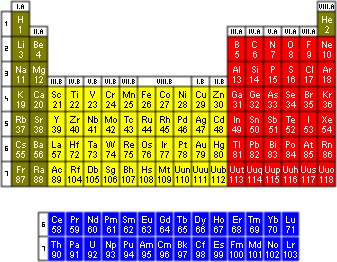
One thing that is easily notable in the table is that there are distinct blocks, coloured differently in the table on the right. The green and red blocks consist of what are termed "the main group elements"; the yellow block is referred to as the "transition metals" and the blue block makes up the "rare earth metals" also called the "lanthanides and actinides". Each block has characteristic traits and give rise to interesting science. A lot of research has been devoted to studying periodic trends. It is important to acknowledge the blocks because they influence trends. For instance, going down a column in the main group block (example: group 14-carbon, silicon, germanium, tin, lead) we see that bond strengths decrease; however, going down the column in transition metals (example: group 8-iron, ruthenium, osmium) shows an increase in bond strength. 

Take a look at group 14 again, we see that silicon falls right below carbon. Ever wonder why science fiction nerds make comments, jokes, references to silicon-based life forms? The answer falls in the periodic table. Because silicon is below carbon, it has similar properties. We are carbon-based life forms. The ability of carbon to catenate (meaning it bonds to itself in long chains of covalent bonds) well is what allows for life on this planet; silicon, being in the same group, also catenates well, theoretically meaning that it could form the backbone of life on a different planet. 
It should be noted that there are some out there who feel that there are better, more accurate arrangements of the periodic table.

Mendeleev's table will forever be the first incarnation, quickly igniting revolution in chemistry.


References:

Petrucci, R. H.; Harwood, W. S.; Herring, F. G. General Chemistry 8th ed. 2002 Prentice-Hall Inc. Upper Saddle River, NJ.
Balchin, J. Quantum Leaps: 100 Scientists Who Changed the World 2010 Arcturus Publishing Limited., London. 

Gray, T. The Elements 2009 Black Dog & Leventhal Publishers Inc., New York, NY.


Monday, December 12, 2011

Quasicrystals: A Nobel Story-A Follow Up

Since the Nobel Prize ceremony has taken place, I thought I would follow up with Dan Shechtman's story. I just watched a video of his Nobel lecture and wanted to share it. I think the overall message that he talks about is important to anyone pursuing enlightenment, not just scientist. His first statement: "Be humble". What would be the fun of doing research if we already knew everything there was to know about a subject? At the end of his talk (if you aren't going to watch the whole thing, at least skip ahead to the last five minutes) he talks about having courage and tenacity and belief in yourself. I think that that is the best part of this story. He was willing to stand by his results and what he believed was correct in the face of extreme opposition-he did go up against two time Nobel laureate Linus Pauling (and won!).  He backed up his claims with meticulous, well-planned experiments. Very inspirational.

So without further ado, Dr. Shechtman

Saturday, November 26, 2011

Don't Worry, It's a Dry Cold

When people first move to Edmonton, they quickly begin hearing tales of how cold our winters are. These tales are met with the exasperated shout of disbelief: "It gets HOW cold?!" To which native prairie dwellers, such as myself, reply: "Don't worry, it's a dry cold." So what? Ever wonder why it feels way colder at -10 in Guelph than it does at -20 in Edmonton? It has to do with humidity (or the lack of) and a branch of chemistry referred to as "thermochemistry".

Our story begins with James Joule (1818-1920) and the first law of thermodynamics. Joule, being a brewer by trade, also shows us that chemists are rarely far from ethanol. 

First Law of Thermodynamics: energy can neither be created nor destroyed, only converted from one form to another. Heat is a form of energy. It can be transferred across the boundary between a system and its surroundings. Temperature is the measure of heat. Also important to know it that the direction of heat transfer is always from the thing that has the heat to the thing that doesn't. So leaving your front door open in the winter will not let any cold air in. It is physically impossible; however, you can let a whole lot of heat out. Another important term to know is heat capacity: the amount of heat required to change the temperature of a system by 1 degree. 

It is currently a balmy +1 in Edmonton right now.  The North Saskatchewan river isn't even frozen over, but I can tell you with certainty, I will not be jumping in for a swim. Even though the temperature of that river is actually warmer than the air surrounding it, it still feels a heck of a lot colder. This is because heat transfer is more efficient between a liquid and a solid than it is between a solid and gas. Heat is lost, at a molecular level, by collisions between the warmer body (you) and the colder body (the river or the air). Because of the fact that a liquid is more dense than a gas (especially a gas at cold temperature), there are more opportunities for molecules to collide, meaning more opportunities for heat transfer. The other important point is that the heat capacity of water is really big. Meaning that it takes a lot of heat to warm the water just one degree. If there is a lot of water in the air, it can condense on you, giving you that "wet" feeling. This will lead to more opportunity for heat transfer, making you feel much colder at -10, than if you are living in a place like Edmonton, where it is so dry that your skin begins to feel like an exoskeleton that you are much too big for. (I recommend Moisturel as a moisturiser for anyone looking to combat dry skin.) 
This heat capacity of water isn't all bad though. Ask people in Vancouver. See, because water takes so long to heat, it also takes a really long time to cool. Meaning that in the winter, places near water, like Vancouver, don't get that cold. Of course, one big snow storm and the whole city shuts down because they only own one snow plow, and have no idea how to function in weather that gives the rest of Canada the monicker "The Great White North". You can also use this heat capacity to your advantage when cooking dinner. Want to thaw your frozen meat faster? Stick it in room temperature water. 
So Edmontonians, when that mercury dips, and your skin and hair desiccate to a point beyond all recognition, be thankful for it. After all, it's a dry cold, so it really isn't that bad. Just bundle up.  

References:

Petrucci, R. H.; Harwood, W. S.; Herring, F. G. General Chemistry 2002 Prentice Hall Inc., Upper Saddle River, NJ.

Balchin, J. Quantum Leaps: 100 Scientists Who Changed the World 2010 Arcturus Publishin Limited, London.
Laidler, K. J.; Meiser, J. H.; Sanctuary, B. C. Physical Chemistry 4th ed. 2003 Houghton Mifflin Company, Boston, MA.

Sunday, November 20, 2011

Winter Tires: Don't Tread the Snow

Well winter has arrived in Edmonton. It is currently -17, with a windchill that makes it feel like -25 C. Over 15 cm of snow has fallen in 72 hours. The roads have become a delightful mix of ice and snow, making driving difficult. And it is not just here in Edmonton that citizens have been hit with a mound of snow and freezing temperatures. Calgarians are currently praying for their next chinook. So how can chemistry help you survive winter? With the science of winter tires! Why are winter tires mandatory in Quebec? Why are some Albertans lobbying for the same law in this province? Are winter tires that important? Well, anyone I have asked have all stated that they love winter tires and are shocked at the difference it has made. The difference all comes down to glass transition temperature (Tg). 

Take a look around your home. I am sure that you can find numerous examples of different types of plastics. Some are rubbery, some are hard, some are fiberous. These characteristics are going to determine how different polymers (plastics are a type of polymer) are going to be used. Now think of a plastic bucket. The kind that you may have used as a kid to build sandcastles. That thing was indestructible during the summer, but leave it outside in Edmonton right now and drop it, that same bucket would shatter into a million pieces. What we are observing is a change in "state" of the polymer. Now this might sound odd, considering it is still solid, and the states of matter are solid, liquid, and gas. So how can we be seeing a change in state? Enter the glass transition.

Polymers can have two solid states: they can be glassy; these are hard plastics, like cellphone cases and water bottles; or they can be rubbery; these are flexible plastics, like rubber balls, or tires. The glass transition temperature (Tg) is the temperature at which a polymer switches between the glassy state and the rubbery state. If a polymer is used BELOW its glass transition temperature, it will be glassy or hard. If a polymer is used ABOVE its glass transition temperature, it will be rubbery or flexible. The polycarbonate water bottle on my desk is an example of a plastic that I am using BELOW its glass transition temperature, while the flexible silicone spatula I used to make my breakfast is an example of a plastic I am using ABOVE its glass transition temperature. Going back to the plastic bucket example: in the summer, the bucket is above its Tg, so there is some flexibility to it and therefore, doesn't break easily. In the winter time, the bucket is below its Tg, making it glassy, and more fragile, so it breaks. 

At cold temperatures, rubber tires are also going to go through this change. Rubber tires were such a great advancement (thank you John Boyd Dunlop) in the tire because these air-filled rubber tires absorbed shock, had more contact area with the road surface, and consequently, gave more traction. The more a tire interacts with the road, the more traction a vehicle has. In the snowy, icy winter, we need all the traction we can get. To get a nice, flexible tire that has lots of contact with the road, it needs to be used above its Tg. However, in Canada, our winters are going to push that. Our -40 C winter days are going to bring a regular tire down to, if not crossing, its Tg. This will make it more rigid, and therefore, it will have less contact with the road surface, which will decrease the traction, precisely at a time when drivers want MORE traction. Also, the treads on the tire will become less flexible, allowing for snow to build up in them, further reducing traction.

Winter tires are made of a type of rubber that has a much lower Tg than summer tires or all season tires. This means that even as the mercury drops, the tire will not approach the Tg, and will stay flexible, resulting in more road contact, less snow build up, and MORE TRACTION. More traction means less sliding, smaller stopping distances, and safer driving. Enjoy safer winter driving thanks to the chemistry of polymers and the glass transition temperature. Get yourself some winter tires.    

For further winter survival reading check out a previous entry: Careful of the Icy Patch

Want more on winter survival through chemistry? Be sure to leave your questions and comments.


Monday, October 31, 2011

Quasicrystals: A Nobel Story

The announcements have all come in for the Nobel Prizes. It is the highest honour for a scientist. So who won the 2011 Chemistry Prize, in this International Year of Chemistry? Why Dr. Dan Shechtman, a professor of materials science at Technion-Israel Institute of Technology.

Shechtman's work concentrated on crystallinity, but what made his work so interesting, is that he discovered "quasicrystals", a concept previously held to be impossible. His work was met with a lot of criticism and skepticism. His results were suggested to be artifacts, or misinterpretations of microscopy results. His colleagues would hand him textbooks to study, pointing out that these books would clearly show his results were impossible. Overtime, these results were observed by other scientists, and the intense debate began to swing in Shectman's favour.

So what are these interesting and controversial materials Shechtman discovered? Quasicrystals. In crystallography, a crystal is a material in which the atoms are structured in a particular geometric pattern that repeats itself in three dimensional space. These repetitions are at fixed intervals. This means that there are clear definitions of what is allowed symmetry in the crystals, and the 5 and 10-fold rotational symmetry that Dr. Shechtman observed in his materials is certainly NOT allowed by conventional crystallography. In conventional crystallography, crystals may display rotational symmetries of 2, 3, 4 and 6. The reason that 5 fold periodicity is not allowed is because it cannot be exhibited by the crystal as a whole. While a single pentagon many have 5-fold symmetry, an array of pentagons will lack this symmetry. The previously held definitions of crystallinity included periodicity and yet Shechtman's crystals did not have this periodicity. Moreover, these crystals, that lacked the periodicity, were still ordered crystals. The result of Shechtman's work was a redefinition of what it means to be "crystalline" and the introduction of the concept of "quasicrystals".  

To better visualise this concept of periodicity and ordered structure take a look at the picture on the left. Taking a look at it we can agree that there is structure to the pattern, and it does follow mathematical rules, but the pattern is not regular. You cannot fold any part of this image onto itself. The pattern simply doesn't repeat. 

I think one of the most important lessons that we can take from Dan Shechtman is the importance in standing by your data. Too often we as scientists get biased by what we think "should" happen, or what we want to see happen. It becomes easy to shut down new possibilities and new ideas that can change our perceptions and give us a better understanding of the world. After all, is that not our goal in science? Shechtman stood by his data, ensured that his experiments were meticulously done, and did not capitulate to scientific peer pressure. He was able to win ultimate vindication in the form of a Nobel Prize. Congratulations Dr. Shetchman, your story is most inspirational to this chemist, and I hope to many others: scientist and non-scientist alike.

References:

Chemical and Engineering News, October 10th, 2011
West, A. R. Basic Solid State Chemistry 2nd Ed. 1999 John Wiley and Sons Inc. West Sussex, England.

Friday, September 23, 2011

The Chemistry of Flame Retardants: A Follow Up

Here is an interesting follow up to a previous entry on flame retardants. In the September 5th issue of Chemical and Engineering News an article was published on "greener flame retardants" http://pubs.acs.org/cen/news/89/i36/8936news8.html

Researchers have developed a two different types of coatings. In one case, researchers are using a thin coating of two polymers, poly(sodium phosphate) and poly(allyamine), in alternating layers on cotton. Material that was coated was shown only to char on exposure to flame, where uncoated material completely disintegrates. 

The second coating is one made of clay, or more scientifically, montmorillonite, that is alternated with chitosan-a polysaccharide that makes up the exoskeleton of insects. This was then coated onto a polyurethane foam and the result of the flame test showed that the material only charred.  

So what we see here are strides that are being made to find flame retardants that are as effective as halogenated flame retardants, but do not posses the environmental impact of halogenated flame retardants. 

To quote Nobel laureate Richard Smalley: "Save the world, become a scientist."

Saturday, September 10, 2011

The Wizard of Os

This post has been inspired by a reaction that I am too terrified to try. The reaction is called an oxidative cleavage and is done using osmium tetroxide, or OsO4. I was once referred to as "osmiphobic" by one of my committee members during my candidacy exam. So lets take a look at this element called Osmium and then discuss why I am so afraid to work with OsO4. 

Osmium is element 76 on the periodic table. It is found in the transition metal section (the middle part) at the bottom of the same column as Ruthenium (Ru), element 44, and Iron (Fe), element 26. Osmium has an atomic mass of 190.23 g/mol. What is so neat about this metal? Well, unlike most metals, Os isn't grey (or silver). It is actually VERY faint blue colour. Other metals that are not grey or silver are gold (Au), element 79, and copper (Cu) element 29. 
Osmium is actually the hardest pure metal on the Brinell scale. http://en.wikipedia.org/wiki/Hardnesses_of_the_elements_%28data_page%29 Osmium is not the hardest element (carbon: in its diamond allotrope) or even the hardest material, these are mixtures of various elements. But in its pure form, it is the hardest metal. And metals make up the majority of the periodic table. Its hardness has made osmium useful for writing implements and is therefore found in the nibs of fountain pens. It was also used in the tips of needles for phonographs, which are (were) subject to significant ware. 

Interestingly, compared with other metals in this area of the periodic table, gold, rhenium, platinum, that are oxidation resistant, osmium will oxidise slowly in air, forming OsO4. Which brings us to this compound I am freaked out about working with. 

OsO4 is a solid material, but it is actually quite volatile. It will sublime (a process whereby a solid is converted directly to a gas without proceeding through a liquid state)  at room temperature. This is HIGHLY TOXIC! As a matter of fact, a small, sealed ampule of OsO4 obtained from Sigman-Aldrich has "highly toxic" or "very toxic" written on the label in no less than four places, with the accompanying "skull and cross bones" symbol of death. Have a look at the Materials Safety Data Sheet (MSDS) for this compound: http://www.2spi.com/catalog/msds/msds02595.html it is NOT pleasant. It has an extremely low LD50 (the amount necessary to cause the death of half of a sample set population-usually conducted on mice, rats, or guinea pigs). It is rumoured to have a smell something akin to that of ozone; however, if inhaled at levels well below that required to register a smell, this compound can cause pulmonary edema, resulting in death, so I am not anxious to confirm the smell of this compound.
Now I have worked with some pretty nasty chemicals: lead tetracetate, sodium cyanide, sodium azide, dimethyl aminopyridine (DMAP) the list goes on and on. Why I feel this compound is so different is because of this volatility. In its vapour phase, it is much easier to penetrate the safety barriers set up. For example: one should not wear typical safety glasses, but seal goggles because of the ease in which a vapour gets past safety glasses and the fact that one of the main target organs for this compound is the eye. It is much harder to protect against a vapour. 

There is a related compound for oxidative cleavage called ruthenium tetroxide, RuO4. Ruthenium is right above osmium on the periodic table. The difference between RuO4 and OsO4 in this reaction is that that RuO4 oxidises to the carboxylic acid-the highest oxidation state of carbon, while OsO4 oxidises only to the aldehyde-the second highest oxidation state of carbon. This is because of a neat little trend of transition metals. Anywhere else on the periodic table, the bonds get weaker as one moves down the table. But in the transition metals have the opposite trend, the bonds get stronger. This is why most catalysts are still made from the more toxic transition metals further down, rather than the less toxic transition metals in the first row, like nickel, copper, and iron. The bonds are too weak and fall apart easy. The metals in the last row are often not used because the bonds are too strong. Leaving the middle row as the "Goldie Locks" row-the bonds are just right. In the case of OsO4 though, those strong bonds work to our advantage by preventing over-oxidation. 
So that is the story on osmium and osmium tetroxide. I am sure one day I will get up the courage to work with this chemical, making sure to practice safe chemical handling techniques when doing so. I have, after all, worked with other equally nasty chemicals. 

Reference:
Gray, T. The Elements 2009 Black Dog & Leventhal Publishers Inc., New York, NY.