Wednesday, December 26, 2012

Can't Sleep, Thesis Will Eat Me

I know I have been remiss in writing here lately, and I greatly appreciate the number of comments/questions. Too bad it has taken me so long to get back. I shall blame it on writing my thesis. After spending an entire day writing (or staring at a blinking cursor, trying to write-depending on how good my day is) I just don't seem to want to write more on my blog. Although, this is much more fun. 

But with all of the writing I have been doing, I have had the luck of getting a paper published. It is one I have been working on for more time than I care, but the scientific community has agreed to publish it (who am I to argue?) so here is a link to my paper , just to prove that I am a real scientist with actual real credentials. 

I intend to write something here soon, but please don't let my slow response keep you from reading, or asking questions. 

Chemistry is awesome!

Thursday, September 20, 2012

Operation Thesis Continues

I am still working away at my thesis. It really means that I am having trouble coming up with ideas for blogs on my own. So please ask me some questions. I am desperate for new ideas to write about. I have a few thoughts, but maybe some feedback with let me know whether there would be any interest:
1) vaccines-what they are and how they work

2) fluorescence-because of that whole mountain dew myth

3) what is a flame? This might really be my attempt at answering Alan Alda's "what is a flame?" challenge. 

And I am out. Please ask your questions. And also vote on whether or not you would like to see a post about any of the above topics.
 

Saturday, August 11, 2012

Ask a Chemist: Operation Thesis

It never fails that when I am away for a bit, that is when I get numerous questions. I apologise for my delay in replies. 

Please keep your questions coming. 

I have begun writing my thesis. The completion of this masterpiece is under the label: Operation Thesis. Along the way I shall be happy to share what I learn. Also, I am looking for the distraction.

Tuesday, July 3, 2012

Happy (Belated) Canada Day!

This past weekend was Canada Day. And tomorrow, for Americans, is Independence Day. Common to both of these holidays is celebrations that demonstrate the best use of gunpowder. What I mean to say is FIREWORKS! Without chemistry there would be no fireworks so to share a little about the chemistry of fireworks let me introduce you to a video from the American Chemical Society. Chemistry of Fireworks.
Enjoy!

Friday, June 1, 2012

Chemisty of Stain Removal

I am just returning home from the 95th Canadian Society for Chemistry conference, which was hosted in Calgary, Alberta this year. One of the great things about going to Calgary for me (aside from visiting the zoo) is that my sister lives there. Instead of staying in one of the over-priced hotels near the conference centre, I was able to stay in one of the over-priced downtown apartments near the conference centre. This was great! And sure, the accommodation may not have had the most comfortable bed, it did come with free internet, home cooked meals, and a couple of cats to snuggle with. Oh, and family that I love. In this time though, my sister found that having a free-loading chemist as a house guest isn't all that bad. Not only will she leave her fabulous shoes for you to wear, she can apply her knowledge to help you remove a baked-in oil stain from one of your favourite sweaters.

The stain: in an expensive and great lululemon zip-up hoodie, an oil stain that was very visible was set in the pockets. The sweater had been machine washed and dried. Its distraught owner was quite sure nothing further could be done for the sweater. It was to fall victim to this villainous stain. 

Our heros: a chemist, canola oil, and dishsoap. The canola oil was rubbed into the stained areas. Then dishsoap was poured on top and also rubbed in. The sweater was then thrown back into the washing machine.

The outcome: one stain-free sweater, good as new.

That's right, we used oil to remove oil. Magic right? Not so. Here's the chemistry: because the oil had been washed and dried, it was now trapped in the fibers of the fabric and therefore  not accessible to soap when further washing would take place. This is because water and oil, as the saying goes, don't mix. This creates a barrier between the oil in the fibers and the soap. In order to get the oil out then, we need to find a medium that it does mix with. This is where the chemistry phrase "like dissolves like" comes in. Oils are soluble in other oils. Any oil will do: canola, olive, WD40, take your pick. By rubbing the oil onto the stain, it is able to dissolve the oil that is set into the fabric fibers. Once it has, you pour on the dishsoap, and the soap does what soap is designed to do, and form what are called "micelles" around the oil particles that can now be washed away in water. The result is a stain-free fabric. 

I talk a little bit more about some of the factors involved in my blog about water. The terms hydrophobic, hydrophilic all play a role in this chemistry. Oil is hydrophobic: water-hating. Soap is what is called "amphiphilic", meaning that one part of it likes water, while the other part doesn't. When placed in water it will arrange itself in the small spheres (micelles) with the hydrophilic (water-loving) part facing out into the water, the hydrophobic part facing in. Because oil is also hydrophobic, it ends up on the inside of these micelles, away from the water.    

So there you have, practical chemistry to save your clothing from destruction!
 

Wednesday, May 9, 2012

Starbucks is Serving What?!

I dedicate this particular post my sister. 

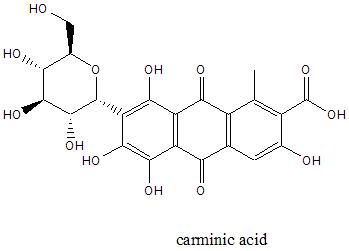
Basically what I gather is that some person found out that their red or pink food dye that makes their Starbucks frappuccino a delicious-looking pink came from insects and this caused some vegans to get upset since apparently bugs count in the abstinence of eating animal products. You can step on them, you just can't eat them. Whatever, that's not really what I care about. What I care about is the chemistry, so let's talk about this red dye:

It is carmine. Carmine is the aluminum salt of carminic acid (shown above). Carmine is also know as natural red 4. Where does the "natural" come from? "Natural" means that it has been isolated from nature, meaning not synthesised in a lab by chemists like me, otherwise it would be referred to as "synthetic" or "artificial". In this case, carminic acid (and similar compounds) are isolated from the scales of insects. There are various methods to prepare this compound, and the more pure, the deeper the colour. 

This is the red in lipsticks, paints, inks, and food products. There have been instances of allergic reaction to this compound-as with most other chemicals, both natural and artificial. 

So if natural is not what you want in your food (FYI you can add this naturally derived chemical to juice and still label your product as having not artificial colours) and you would prefer not to have bug extract in your food, what is left for you is synthetic dyes. 

Synthetic dyes are ones that are made in labs by chemists like me. I like the idea of Starbucks having to switch to synthetics-it means I will be employable. (Ok, I am being a little facetious there.) Synthetic isn't bad either. Food dyes, cosmetic dyes are treated like any other consumer product and have to meet certain legislated standards, not unlike what I described for pharmaceuticals. But the draw back of going synthetic means that there will be some chemicals that have been derived from oil that are used in the process. It is all a trade off.  This particular compound, carminic acid, was first synthesised in 1991 in the lab of John Tyman: Journal of the Chemical Society-Chemical Communications, 1991, 18, 1319-1320.

While many dyes and pigments are derived from plants, not all are. This is a case where insects are used. Tyrian purple, also known as royal purple, was obtain from a kind of shellfish.

Thursday, March 8, 2012

Pharmaceuticals-How Are They Produced?

I thought I would talk a little about pharmaceuticals. Chances are you take some, know someone who takes them, and have all complained about their prices. This past semester, I took a pharmaceutical chemistry class taught by scientists from Gilead, and I must say it was very enlightening. I thought I would share some of the lessons I learned and some of the key problems that face those charged with making these chemicals that many people depend on.

Let's start with a poignant news story. What would you do if you were suddenly unable to get a hold of a medication that you require? When a company decides to stop producing a compound, what can be done? Is that right or wrong? How should medications be priced? These are questions that are very difficult to answer.

To understand a little bit about the complexity of the issues with the pharmaceutical industry I think it is first important to understand how these medications are produced. I know I found it eye opening. Guess how long it takes to produce a drug? 0-5 yrs? 5-10 yrs? 10-15 yrs? 15-20 yrs? If you guessed 15-20 yrs, then you would be correct. It takes 20 years and (as of 2008) $1.7 billion to develop a SINGLE drug. 

The timeline:

Discovery/Preclinical Trials
Time: 1-3 years

In this time, the company will begin by identifying a medical need, such as anti-HIV medications, and then study that disease to determine where drugs can target the disease and the possible interactions of the drug. This is where potential contenders for a drug are determined. This amounts to some 30 000 chemical compounds will be screened! These preclinical trials will involve pharmacodynamics and pharmacokinetics.

Pharmacodynamics: studies how a drug interacts with a target-this is the impact of the drug on the body. Is the drug going to do what is was intended to do? Is it going to do something else? 

Pharmacokinetics: this is how a drug is transported to the target-this is really looking at the impact of the body on the drug. This looks at four things: absorption, distribution, metabolism, and excretion. Remember, your body is one self contained complex chemical reactor. I think one excellent example of the importance of studying this effect is the notorious thalidomide. There are two versions of thalidomide: R and S. One is an anti-emetic (R) while the other causes birth defects (S). Yes it is possible to separate the two and give a person only the version that DOES NOT cause birth defects; however, once in the body, the drug is inter-converted to the other form (a process called racemisation).

Any potential drug will be screened for toxicity using two species: one rodent and one non-rodent. They will be tested for single and repeated dosing. They will be tested by various delivery methods. (Side note: a 14-day rat trial costs $250 000.)

During this time, chemists will be answering the questions of: can the drug be made? How many steps (hint: more steps, more costly, more trouble)? What are the yields (not all chemical conversions give 100% yield-actually very few give 100%)? Is chemical manufacturing possible, feasible, and affordable? 

After all of this, about 100-200 of the 30 000 compounds will make it on to the next step. 

Safety Review
Time: about 30 days 

This is where the pharmaceutical company is trying to get approval from human clinical trials. All of the information gleaned in the preclinical trials must be presented to the regulatory bodies, including the synthetic routes for production. This is also the time that a company will take out a patent on a compound (a process in the tens of thousands of dollars for each one). 

Clinical Trial: Phases 1, 2, 3:
Time: 2-10 years

This is where the human trials begin. 

Phase 1: 
- 10-100 volunteers
- months to 1 year
- involves "proof of concept" and determines whether the drug is adequate, safe, tolerable. 
- 50-70% of the compounds (that made it to clinical trial) will be abandoned. 
Phase 2:
- 50-500 patients 
- 2 years
- 60% of the compounds (that made it to phase 2) will be abandoned
Phase 3:
- 500-2000 patients
- 3-5 years
- only 4-10% of compounds will succeed

Approval:
Time: up to 7 years

This is the stage where regulatory bodies determine if a drug is safe enough and effective enough to sell to the population. 

Now if you have been keeping track, we are about 15 years from when the patent was filed to the point that the drug can be sold. A patent is only good for 20 years; therefore, a company only has about 5 years to recover the cost of the production. This also means that drugs that are currently hitting the market were just getting out of preclinical trials in 1996.

During this time, optimisation is ongoing to make the manufacturing process safer, cheaper, and more efficient. However, if the process is changed too much, it may mean that a company will need to refile their drug for approval. 

There is lots of interesting chemistry in pharmaceutical production. I think I will leave that for another entry, but if you have found this interesting, please check out these course notes for reference material.